
Many terms have been used to describe language intermediaries. That is true in monolingual situations, as professionals can be involved in record-keeping, shorthand, précis-writing and the like. When there is communication across languages, the most obvious distinction is between writing and speech: between translation and interpreting. That difference is clear in today’s language professions, though interpreters are often referred to as translators. If we look back in time, the different terms used can shed some light on the way the two activities have been understood. Restricting consideration to French and English, and going no further back than the seventeenth century, we can get a sense of the linguistic background and history of the term “interpreter”.

Où est le truchement, pour lui dire qui vous êtes, et lui faire entendre ce que vous dites ! Vous verrez qu’il vous répondra, et il parle Turc à merveille. Holà ! Où diantre est-il allé ?1
INTERPRETE, s. m. celui qui fait entendre les sentimens, les paroles, les écrits des autres, lorsqu’ils ne sont pas intelligibles. Voyez Dragoman.2
Interpreter person who elucidates the feelings, words and writings of others when they are not intelligible.3
Truchman
When Jean Jacques Rousseau found himself interpreting for Athanasius Paulus in 1731, he said that he acted as the man’s truchement. The term was derived from the Arabic turjumān (ترجمان). Le terme arabe a été introduit en Europe par l’intermédiaire de langues comme le provençal, où il a donné “drogman” (interprète) au XIIe siècle, puis “trucheman” à la fin du XIVe siècle. Le terme “truchement” apparaît au milieu du XVe siècle, d’abord pour désigner un interprète.4
The term appears in the 1751 Encyclopédie, which stresses its oriental roots: Truchement, (Hist mod.) dans les contrées du Levant signifie un interprète.5 The Encyclopédie is known to have been inspired by Chambers’s 1728 Cyclopedia, which gives the following definition: TRUCHMAN, Dragoman, or Drogman, in the Countries of the Levant, an Interpreter. See Dragoman.
Molière
Molière was familiar with the term truchement. There is a (pretend) truchman in Le Bourgeois Gentilhomme. The middle-class gentleman, M Jourdain, is tricked into believing that he is meeting a Turkish nobleman who wants his daughter Lucile’s hand in marriage. The supposed Turk is in fact her suitor, the commoner Cléonte, who has resorted to subterfuge as Jourdain would not consent to his marriage to Lucile. Cléonte’s valet Covielle acts as the interpreter for the “nobleman”.
CLÉONTE.
Bel-men.
COVIELLE.
Il dit que vous alliez vite avec lui vous préparer pour la
cérémonie, afin de voir ensuite votre fille, et de conclure
le mariage.
MONSIEUR JOURDAIN.
Tant de choses en deux mots ?
COVIELLE.
Oui, la langue turque est comme cela, elle dit beaucoup
en peu de paroles. Allez vite où il souhaite.6
It is not surprising that Molière chose to have Cléonte masquerade as a Turk. The Levant played a significant role in seventeenth century French trade. The Encyclopédie makes that clear in the entry on dragomans:
DROGMAN ou DROGUEMAN, (Hist. mod. & Commerce.) on nomme ainsi dans le Levant les interprètes que les ambassadeurs des nations chrétiennes, résidens à la Porte, entretiennent près d’eux pour les aider à traiter des affaires de leurs maîtres … L’entremise des drogmans ou interprètes étant absolument nécessaire dans le commerce du Levant, dont le bon succès dépend en partie de leur fidélité & de leur habileté.7 The Encyclopédie further outlines Louis XIV’s plans for training these interpreters to ensure that business went well.
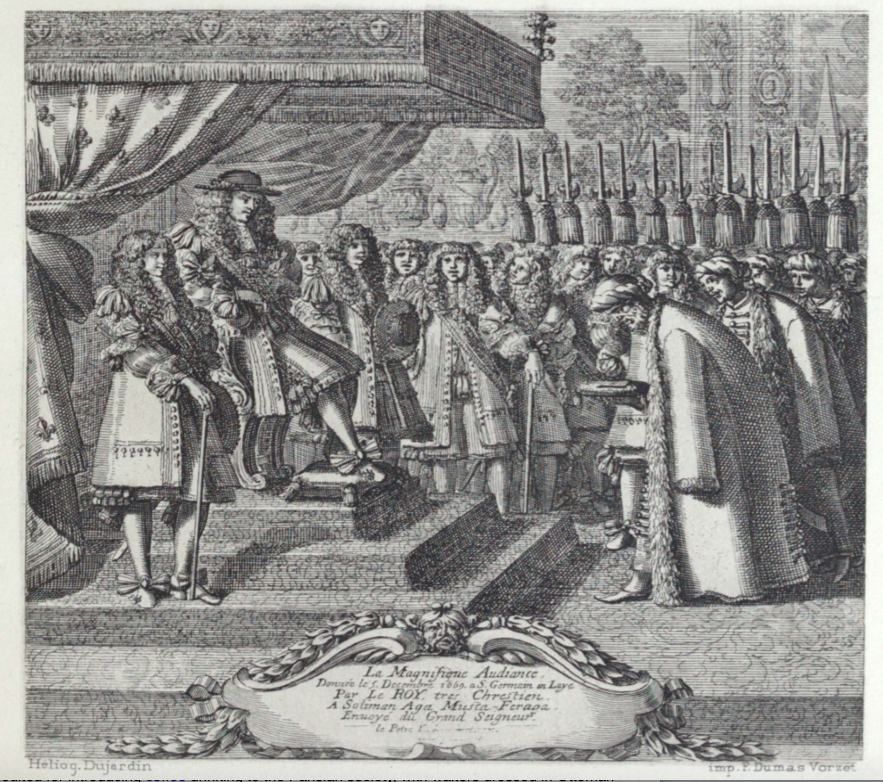
Suleiman Aga
There is another consideration: in 1669, the Ottoman Sultan, Mehmet IV sent an envoy to Versailles. Suleiman Aga was to attempt to improve strained relations between France and the Ottoman Empire. His first audience with Hugues de Lionne, the secrétaire d’Etat aux Affaires étrangères was not a success: the secretary of state chose to receive his visitor in Turkish dress. Whatever the diplomatic point of this strategy, it was soon apparent that the royal translator, M. de la Croix could not speak Turkish – he could only read it. Even in this capacity de la Croix fell short, as he required the dictionary in his library in Paris to translate the letter that Mehmet IV had asked Aga to deliver the the king of France.9
The audience with Louis XIV was a failure too. The king was magnificently attired in diamond-studded gold brocade, whereas Soliman Aga and his entourage seemed shabbily dressed.10 Furthermore, the letter he presented to Louis XIV did not comfirm that he was a diplomatic representative rather than a mere envoy. He was promptly dismissed and the king sought revenge for having wasted his time. While no retaliatory measures were taken against the Ottoman Empire, Louis XIV did indulge in commissioning a divertissement oriental from Lully and Molière: The new comédie-ballet, Le Bourgeois-gentilhomme, featured the topical themes of mistaken identity and miscommunication, and provided a comedic context through which the court could view the Sultan’s diplomatic deception.11

The portrait illustrates the seventeenth-century enthusiasm for Turqueries inspired in part by Suleiman Aga who stayed on in Paris after his 1669 mission to Versailles.12
In time, truchement came to mean an intermediary in the general sense; now it is found in the expression “par le truchement de”, meaning “by means of”. While the term “linguist” or “linguister” was used in the English colonies in North America, and the French referred to their “courtiers” (brokers) in Pondicherry, the preferred terms for spoken language intermediaries came to be “interpreter”/”interprète” (with “dragoman” used for the Ottoman Empire or oriental languages). Their role was so familiar that Molière could rely on its comic possibilities, as did Jonathan Swift in Gulliver’s Travels of 1726.
Gulliver’s interpreter
In Jonathan Swift’s satire on travel writing, Lemuel Gulliver has an audience with the king of Luggnagg. He had learned the necessary ceremonial greeting in the local language.
To this the King returned some answer, which although I could not understand, yet I replied as I had been directed: Fluft drin Yalerick Dtvuldwn prastrad mirplush, which properly signifies, “My tongue is in the mouth of my friend,” and by this expression was meant that I desired leave to bring my interpreter; whereupon the young man already mentioned was accordingly introduced, by whose intervention I answered as many questions as his Majesty could put in above an hour.13
Swift was inspired by the travel writing describing British ventures into the outside world, taking advantage of the complications that can arise when people need an interpreter. Language barriers continue to provide opportunities for invented language, slapstick comedy, and misunderstandings. Interpreters lends themselves to such conceits because of their actual presence alongside their clients; it would be hard to use translation for similar comic effect. That is one way of evoking the difference between the written and spoken transfer of languages, though the two are often confused, with translation commonly used to cover both.

Definitions
Translate (v.): early 14c., translaten, “remove from one place to another,” also “render into directly from Latin translatus “carried over,” serving as past participle of transferre “to bring over, carry over” (see transfer), from trans “across, beyond” (see trans-) + lātus “borne, carried” (see oblate (n.)).14
Interpret (v.): late 14c., “expound the meaning of, render clear or explicit,” from Old French Interpreter “explain; translate” (13c.) and directly from Latin interpretari “explain, expound, understand,” from interpres “agent, translator,” from inter “between” (see inter-) + second element probably from PIE *per- (5) “to traffic in, sell.”15
The etymology of the verbs “to translate” and “to interpret” hint at their differences and similarities. The idea of transferring or carrying meaning across languages that underpins translation, evokes the material nature of the written word and the printed page, whereas to interpret has its roots in expounding the meaning of language. In both cases, we have intermediaries or negotiators.
Long-discussed issues of equivalence and fidelity, adequacy, and appropriateness can be subsumed under the concept of negotiation when this is intended as a compromise in which each party goes back and forth with offers and concessions, and is ready to accept both gains and losses as part of the transaction.16
Both translators and interpreters must be reliable and competent. It is interesting to that the Encyclopédie entry on dragomans stressed that they played a vital role in trade in the Levant, where their loyalty and skill contributed to successful business transactions. A recent definition of trust has it that [t]rust involves expectations about skill and expectations about intentions to help – turning this around, trustworthiness requires both skills and good intentions.17
It is of course possible to take issue with a translator – in the Encyclopédie entry on translation, Nicolas Beauzée does just that:
Ne pouvant pas mettre ici un traité développé des principes de la traduction,qu’il me soit permis d’en donner seulement une idée générale, & de commencer par un exemple de traduction, qui, quoique sorti de la main d’un grand maître, me paroît encore repréhensible.18
Beauzée goes on to crticise de la Bruyère’s translation of a sentence in Cicero’s Brutus “Quis uberior in dicendo Platone? Quis Aristotele nervosior ? Theophrasto dulcior ?”, rendered as “Qui est plus fécond & plus abondant que Platon ? plus solide & plus ferme qu’Aristote ? plus agréable & plus doux que Théophraste ?” He dismisses this version as an inaccurate commentary rather than a translation. These comments are tantamount to literary criticism: an author who challenges a translator’s choice of terms is in a different position from a listener who is unhappy with an interpreter’s work. Unlike translation, interpreting is live. The translator is hidden or subsumed by the written text; you can see (or hear) the interpreter. That physical presence is what makes for the amusing takes on interpreters in fiction but it also makes for some vulnerability in the workplace when questions are raised, as they address their competence, good will or professionalism.
Traduttore traditore is a succinct way of evoking the complexities of moving between languages; it only indirectly highlights the personal investment that interpreters make in real time, and its attendant risks. The nature of their work also means that there is very little, if any, record for posterity. Translators are subject to close reading and commentary for a long time, which means that their work involves a different kind of reputational risk.
Paradox
In both French and English, to interpret can mean to elucidate or explain, as well as to translate orally between languages. One of the meanings of interprète is actor or performer. Le Petit Robert gives these examples: Les interprètes d’une pièce; un grand interprète de Mozart.19 Interpreters can feel self-conscious or nervous; they can suffer from a kind of stage-fright in stressful situations and they can thrive on the simultaneous nature and immediate effect of their work. Conveying a speaker’s message in real time is not like acting in a Molière play, but to the interpreter, it can have a performative side: you are stepping into a speaker’s shoes to convey their message in another language.
That performance is only successful if the interpreter is forgotten, however. Interpretation works best when the listeners link the voice in their ear with the original speaker, not the person conveying that message in another language. However present they might feel, in the end, successful interpreters are as invisible as translators.
- ,Molière,1670, Le Bourgeois gentilhomme, Act V Scene IV. Where is the truchman, so he can tell him who you are and make him understand what you are saying! You shall see that he will reply to you; he speaks marvellous Turkish. Where the devil is he? (My translation, as are those that follow.)
- https://shorturl.at/nSO9h
- https://johnsonsdictionaryonline.com/
- Dictionnaire de l’Académie Française. The Arabic term came to Europe through languages like Provençal, where it became “drogman” (interpreter) in the 12th century, then “trucheman” at the end of the 14th century. The term “truchman” appeared in the mid 15th century, initially meaning interpreter.
- Truchman (modern history) in the countries of the Levant means interpreter.
- Molière, op. cit. Act IV, Scene IV. Cléonte: Bel-men. Covielle: He says you should go with him now to prepare the ceremony so you can then see your daughter and conclude the marriage; Mr Jourdain: So much in just two words?; Covielle: Yes, Turkish is like that, it conveys a lot with very little. Off you go – follow him
- Drogman or Drogueman (modern history and trade) is the term used in the Levant for the interpreters that the ambassadors from Christian nations who live in the Porte have with them to help them with their masters’ business … Dragomans or interpreters are vital to trade in the Levant; its success depends in part of their loyalty and their skill.
- Van Dyk, G The Embassy of Soliman Aga to Louis XIV: Diplomacy, Dress, and Diamonds, emaj Special Issue – Cosmopolitan Moments: Instances of Exchange in the Long Eighteenth Century, December 2017, pp. 1-19, p. 11
- Ibid. pp. 4-5
- Ibid. p. 13
- Ibid. p. 15
- https://shorturl.at/9efHQ
- Swift, J.,https://shorturl.at/ViRTG p. 223
- https://www.etymonline.com/word/translator
- https://www.etymonline.com/word/interpreter
- Federici,F. M., Tessicini, D. eds, Translators, Interpreters and Cultural Negotiators: Mediating and Communicating Power from the Middle Ages to the Modern Era, Palgrave Macmillan, 2014, p. 1
- Hawley, K. 2012, Trust: A Very Short Introduction, Oxford, OUP, p. 7
- https://shorturl.at/ON1mvI am going to give a general idea of translation as I cannot include an extensive treatise on the subject here. I shall begin with an example of translation that still strikes me as reprehensible, even though it was the work of a master.
- Le Petit Robert, 1987


